September 03, 2009

Food Service Workers Buck Secret Organizing Deals

From the September, 2009 issue of Labor Notes

A delegation of U.S. food service workers flew to the Paris headquarters of their employer Sodexo last winter, delivering petitions against the company’s anti-union practices. They also took to the streets, joining French food service workers in the general strike rippling through the country. For one of the Americans, a member of Service Workers United, the act of solidarity abroad would have been a breach of contract back home.

UNITE HERE and the Service Employees (SEIU) had formed the joint union called Service Workers United, or SWU, in 2005. In secret talks with multinational food service giants Sodexo, Compass, and Aramark, the new union traded a lot—including workers’ right to strike—for contracts in a low-wage, hard-to-organize industry dominated by the “Big 3.” Aramark dropped out of the talks, but made a separate pact later that year.

serviceworkers1

To seal the unprecedented deals, contract standards were settled before the first worker signed a card. Workers faced termination if they slowed down or picketed. Conflicts over terms of the agreement would go before a national labor-management committee instead.

The companies, which have contracts to run cafeterias and concessions in schools, stadiums, and corporate offices, reserved the right to choose where the union would organize, and how many total members could join.

Sodexo capped organizing at 11,000 workers and Compass at 20,000 through 2008. Despite that, federal filings show that the union had just 6,000 members last year.

The Big 3 scattered approved organizing sites across the country and forced the union to pull the plug on other drives. The union could reject a site management selected, but it would still count against the quota. The companies also established separate expiration dates for each shop, atomizing members’ bargaining power.

Four years later, the deals with management have collapsed, UNITE HERE and SEIU are embroiled in conflict, and restless food service workers aren’t waiting for distant leaders to come to their rescue.

BOILERPLATE CONTRACTS

As lead negotiator in the 2005 talks, then-UNITE HERE president Bruce Raynor fashioned a national “boilerplate” contract for all SWU members. The new union, christened UNITE HERE Local 2552, set up in the International’s Manhattan headquarters. The office opened a “Workers’ Resource Center,” an 800 number workers were to call for step two grievances. The “national local” assigned each worksite a representative from the nearest UNITE HERE or SEIU local to work with stewards and bargain contracts.

Since details went public last year, the SWU deal has been used to both exalt and disparage organizing-by-partnership models. “We’re dealing with companies that don’t make decisions in our community; they make decisions in their central offices,” said Raynor, in a union video. “And the union has got to have the scope and power to match up with that company.”

Jim Dupont, a former SWU negotiator and now head of UNITE HERE’s Laundry and Food Service division, says SWU’s terms curtailed workers’ ability to fight the boss. “SEIU’s definition of partnership is you do what the company wants,” he says. “Our definition is, you’re treated as an equal.”

After the 2005 deal was struck, hundreds of workers like Daqwell Carrasquillo got called into meetings with their employers where SWU organizers asked them to sign union cards. Now a steward at Blue Cross Blue Shield’s cafeteria outside New York City, Carrasquillo said workers eagerly agreed, and days later had a first contract modeled on the national template. It included job security and seniority language, wage increases, health care, and pensions.

It was an improvement from the non-union days, but well below the standards of other unionized food service workers.

At Chicago’s UNITE HERE Local 1, food service contracts are “very much a work in progress,” according to organizers. Their stronger contracts peg starting pay at $13 an hour. A hundred SWU members at a DePaul University cafeteria, meanwhile, start at $9.25. Under the 2005 deal, companies agreed to pay members at least 50 cents above minimum wage.

Before SWU was formed, UNITE HERE Local 100 represented about half of Aramark food service workers in New York City. President Bill Granfield viewed SWU with cautious optimism. “We didn’t expect SWU members to fall in and hit our standards right away, but we were going to get a bunch more people in,” he said.

The crown jewel of Local 100 contracts, full family health coverage, is a far cry from what their fellow members at SWU have achieved. New York’s SWU members, with salaries around $20,000, pay monthly contributions of up to $400 for family plans.

Four years later, standards nationwide haven’t risen, and the merits of SWU are under fire from members. Carrasquillo and his co-workers haven’t had a raise since 2007, and when they violated the SWU agreement by leafleting outside work for better terms, the company called police.

Now in talks over a second contract, Carrasquillo says the company won’t budge. “Sodexo is cocky,” he says. “They come right out and tell us SWU already agreed to boilerplate contracts, and we can’t change it. But I never voted on anything.”

BREAKDOWN

Granfield says his local planned to break out of the template agreements but SWU leaders haven’t supported his bid. “The local negotiations have been totally limited by the framework at the top,” he says. “We wanted to make strides in second contracts, but that was not SWU’s program. That’s when we started getting angry.”

UNITE HERE’s conventional contracts with Aramark were expiring in late 2007, right as the union and company bargained a new national agreement for SWU. SEIU joined UNITE HERE in a nationwide campaign: strikes erupted in Granfield’s New York local, as well as at UNITE HERE shops in Vancouver, Ontario, and Boston, adding leverage to the SWU talks. SEIU pushed new organizing drives against the company.

Soon after, in summer 2008, Raynor struck an organizing deal with Aramark that UNITE HERE leaders criticize. Dupont says he was kept out of the room while Raynor allowed the company to maintain control over new organizing, forcing SEIU to interrupt an Aramark drive in Houston.

Raynor’s Aramark deal—which later fell apart—added fuel to burning divisions within the union that blew up in March, when he pulled 100,000 members out of UNITE HERE and into an affiliation with SEIU.

But the feuders remained attached at the hip by their joint union, and haven’t accepted a mediator’s proposal to settle food service jurisdiction geographically.

SWU’s leadership is now a part of UNITE HERE only in name. Its two appointed leaders, one from SEIU and one from UNITE HERE, both supported the March exodus. They’ve been reassigning servicing of SWU members to SEIU locals, strengthening the Service Employees’ presence in the industry. Currently, UNITE HERE claims 60,000 food service members nationwide—SEIU has far fewer.

There’s emerging anger in the ranks about SWU. After Carrasquillo filed five grievances through SWU’s call center that weren’t resolved, he picked up the phone again, joining national conference calls with other SWU members two years ago. At UNITE HERE’s June convention he presented a petition signed by 1,000 members demanding a SWU bill of rights. The call for local control, elected leaders, and an end to backroom deals passed, but has no binding effect.

PARTNERING UP

SWU leaders say no national deals currently exist (Compass and Sodexo have failed to give permission for new units), and that the UNITE HERE split has disrupted attempts to resume talks with the Big 3 over new card check arrangements.

They echo SEIU’s call for a settlement so companies can no longer use the rift as an excuse to keep dues in escrow, stall contract talks, and block new organizing. UNITE HERE leaders have sued over the split, willing to pursue a protracted legal process.
“If it takes a long time stop the growth of this corporate unionism, then so be it,” says Dupont.

Raynor calls SWU the most successful private sector organizing project labor’s seen in years—and a model for the future. SWU President Kurt Edelman says the union is mobilizing members (dozens just met in D.C. to lobby for a child nutrition bill) while organizing new ones. Acknowledging lagging contract standards, he hastens to add: “They’re better than what people would get without a union.”

UNITE HERE blasts that idea, pointing to its approach to hotel chains, where a coordinated campaign of strikes and mobilization won new card checks—and contracts that didn’t drag down industry standards.

Four years ago, UNITE HERE and SEIU were on the same page. They left the AFL-CIO, signing partnerships with food-service CEOs soon after. SWU, Dupont says, actually sprang from Wilhelm’s idea to combine the two unions’ efforts at common, institutional workplaces.

But what to do once the deal was signed divided the unions. UNITE HERE leaders saw SWU as a temporary project and claim the two unions had agreed to phase it out. Raynor and Stern want to preserve SWU and the employer-approved approach that gave it legs. Now, UNITE HERE intends to make sure that SWU doesn’t expand.

“We’re not going to let them enter this jurisdiction and be the company’s favorite cheap alternative,” Dupont says. “They want to be the Wal-Mart of unions.”


July 27, 2009

Chicago Charter Teachers Score First Win

From the August, 2009 issue of Labor Notes.
http://labornotes.org/node/2346

CTU Organizing

It’s an oxymoron no longer: charter schools are unionizing.

Pioneering teachers and staff sealed an overdue victory in June at three Chicago International Charter Schools, the state’s largest charter operator.

Although the schools run primarily on public dollars—and Illinois allows public sector employees to unionize by card check—management rejected cards signed by 75 percent of employees in April. The charter operator argued that its unelected board of directors was not “responsible to public officials or to the general electorate.” CICS forced a Labor Board vote, battling for two months until workers voted 73-49 to unionize anyway.

When he championed charters as labs of educational innovation, former American Federation of Teachers(AFT) President Al Shanker thought they’d be organized. Two decades later, nearly all charter operators—despite varied teaching methods and missions—agree on one thing: teachers should be non-union.

Teacher unions now acknowledge charters have become a fact of life, and few would argue against organizing their teachers. But debate rages over how, and whether, to manage charters’ spread.

The AFT says charters work when they’re teacher-driven schools that share innovations with district schools, when the public can exercise oversight, and when teachers can join unions.

The schools have not succeeded by these measures but continue to expand, especially in urban districts. So that’s where the AFT is concentrating attention, picking up wins in Florida, Philadelphia, New York, and Los Angeles.

Instead of fighting tooth and nail to undermine charters, which have steadily chipped away at union ranks and siphoned off public dollars from traditional schools, the union has committed itself, even if belatedly, to organizing their tens of thousands of teachers.

They’ve got their work cut out for them: only around 80 of 4,600 charters are organized nationwide.

EDUCATE, ORGANIZE

In Chicago, teachers began to see their vulnerability to the boss’s whims as a flaw in the school’s educational model. At Northtown High School, workers called meetings when the school’s former CEO—who had no background in education—announced instructors would teach an additional class but be paid the same.

And instead of summer school, teachers would instruct failing students during night school. “If we didn’t like it, they basically told us ‘there’s the door,’” said Emily Mueller, a Spanish teacher.

Teacher turnover was high: “at will” employees were quickly booted, and other teachers simply left, overworked, underpaid, and kept at arm’s length from many curriculum decisions. The founding core of teachers dwindled. At Ellison High, only six of 20 teachers returned to the classroom last year.

To squelch the organizing drive, CICS used both stick and carrot. Two members of the school’s board, lawyers at a Chicago firm specializing in “union avoidance efforts” for groups “whose business is education,” came in with another anti-union consultant to fight the drive.

CICS made nice, too, hiring a new CEO who reversed the class load increase and reinstituted summer school, but opposed the union, calling it a threat to school autonomy—presumably his.

Most teachers had set their sights beyond immediate management regardless. “This drive was about creating a culture in our school where teachers will stick around for years, and have a formal voice in our school no matter what CEO comes along,” Mueller said.

In talks beginning this summer, teachers seek higher wages (entry salaries are several thousand dollars lower than district teachers’) and due process (but not the formal tenure system that exists in district schools), hoping that both help retain committed teachers.

They also want more control over curriculum, but making fundamental changes could be tough. Teachers at CICS are told to prep students on specific parts of standardized tests, which comes at the expense of basic educational needs—like supplies for other classes.

“I was told I’m not a social science teacher, I’m a reading teacher,” says Ellison teacher Jennifer Gilley. “It’s ironic because I taught three classes and only one of them came with a book.”

A TEACHER IS A TEACHER

The Chicago Teachers Union, AFT Local 1, has a conflicted relationship with the charters. Union reps were on hand last spring when charter teachers presented cards to their CEO, and CICS teachers received a warm reception from CTU delegates for breaking into non-union territory.

But a reform grouping within the CTU, the Caucus of Rank and File Educators (CORE), is raising a ruckus.

“If you’re organizing the charters without taking a position on defending existing schools against charter proliferation and expansion, that’s a failed strategy,” says Jackson Potter of CORE.

CORE is targeting Secretary of education Arne Duncan, whose nationwide tour sailed through Chicago in June. He’s offering urban districts additional federal money if they give the mayor executive control over schools, extract concessions from teacher unions, and allow charters to expand.

The strategy is straight from Duncan’s tenure as CEO of Chicago Public Schools, where he hatched a plan that has closed nearly 70 neighborhood schools and established charters in their wake, promising to raise student achievement.

Five years later, a Stanford University study shows a majority of charter schools performing worse than or comparable to traditional public schools on standardized tests. Some in the AFT are calling for a moratorium on charters.

With strong parent and student involvement, CORE rallied to save six district schools from the gallows last winter. But other schools close, and charters keep opening in them—erasing the elected decision-making committees of students, teachers, and parents at each site.

A University of Chicago study—which Duncan’s corporate backers allegedly tried to suppress—shows the city’s charters under-serving special education students and English-language learners. And because of limits on enrollment, many kids are left without neighborhood school.

Though charter and district teachers refuse to succumb to divide and conquer tactics, CORE says existing union strategies are making divisions difficult to avoid.

WHERE TO FIGHT?

Just as teachers won at CICS, the Illinois Federation of Teachers negotiated a state law allowing 45 additional charters to set up in the city. Though they constitute only 3 percent of publicly funded schools nationwide, charters are 10 percent in Chicago, a share that will now rise again. IFT inserted provisions that beef up oversight of charters and allow charter teachers to organize under the state’s card-check provision for public employees.

The AFT’s organizing pitch is finding a growing audience among charter teachers, says Hugo Hernandez, an AFT staffer. The way to affect charters’ impact on education, he argues, is to bring them into the union. “If they would open the doors, we could find out what’s happening in these schools,” he said. “And to do that, we’re organizing.”

CORE wants the union to defend neighborhood schools and slow charter growth, but with the bludgeoning of teacher unions in the media, AFT is reluctant to fight Duncan’s strategy, which also has the blessing of the Obama White House.

Meanwhile, Chicago teachers—who’ve seen a 6,000-member drop in a decade—are bracing for another wave of non-union charters crashing into neighborhoods. “Perhaps they’re bargaining from a position of weakness,” Potter said of union leadership. “But that weakness is going to mean the end of us all before too long.”

July 02, 2009

Dancing with Death: "Waltz with Bashir"

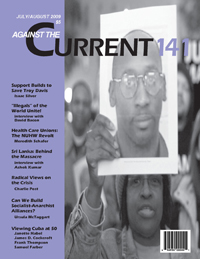
My review from the July/August, 2009 Issue of Against the Current.
Watch the film here:

http://www.solidarity-us.org/images/ATC141200.jpg

(“Vals im Bashir” in Hebrew)
an animated documentary film written and directed
by Ari Folman, 2008.

IT TOOK ARI Folman 25 years to make “Waltz With Bashir,” his animated film about Israel’s 1982 invasion of Lebanon. First, he had to remember the war.

[For our own readers who don’t remember: The Israeli government under Menachem Begin and Ariel Sharon invaded Lebanon under the pretext of driving the Palestine Liberation Organization (PLO) away from the Israel-Lebanon border. The Israeli Defense Force (IDF) seized control of the entire country up to Beirut, culminating in a horrific slaughter of Palestinian refugees by Israel’s rightwing (“Phalangist”) Lebanese allies and a bloody 20-year Israeli occupation of the south of the country — ed.]

Folman was 19 during his stint with the IDF in Beirut, stationed a few hundred yards from the massacres of hundreds (some claim thousands) of Palestinians in the city’s Sabra and Shatila refugee camps. In the film’s opening scene a graying Folman listens to his war comrade Boaz tell of a recurring nightmare: the 26 guard dogs he killed during the invasion hound his sleep.

Folman, for his part, says he recalls almost nothing about the war: “It’s not in my system,” he tells Boaz.

At the advice of a therapist friend (Folman underwent analysis while making the film), he seeks out friends who saw combat. Their stories become flashbacks that fill the animated documentary, as Folman, hounded by a troubling lack of memory, tries to piece together his own role in Ariel Sharon’s butchering of Beirut.

http://filtnib.files.wordpress.com/2008/12/waltz_with_bashir-blue.jpg

We're tempted to ask: Why did it take so long to remember? But on top of the widely experienced suppression of war trauma, Folman's forgetting is helped along by a willful amnesia that's inseparable from Israel's national story. Denying a catastrophe is required to celebrate independence. Founding mother Golda Meir maintained that Palestinians “did not exist.” Charitably, the Israeli officialdom “neither confirms nor denies” the existence of its nuclear arsenal.

Folman hasn’t forgotten alone. He places himself in the film to confront this denial, opening questions about his past before the Israeli public.

White phosphorous rained on Gaza while the film picked up awards worldwide. As it wrapped up its tour of the States, Israeli soldiers testified to war crimes during the early 2009 bombardment.

But “Waltz” doesn’t actively connect Folman’s narrative to a legacy of Israeli theft and brutality. Instead, it could offer those who share his guilt a deep sigh of release from the isolated incident, when Israel waltzed briefly with the Phalange as they passed through the IDF’s green light into the refugee camps.

Folman has maintained in interviews that the Lebanon war was wrong because it was not a “survival war,” like 1948 or 1967 — the land grabs defended as existential struggles. From this perspective comes “Waltz,” an antiwar — not anti-colonial — film. He illustrates the hellishness of this particular episode in the Israeli colonial project, but avoids the colonial dynamics of the violence, refusing to turn a critical glance toward Zionism itself.

Instead we’re thrown into Lebanon, 1982, without mention that the invasion marked the beginning of a long occupation of the South — and the eventual ascent of its criminal architect to Israel's top post.

The Animation Technique

Animation depicts the shakiness of memory and dreams, but also allows Forman some buffer from a reality he’s uncomfortable with. His combination of cartoon and documentary (drawing on interviews with war veterans) allows him to produce what is ultimately a highly interpretive film.

Just as the stories begin to construct a narrative of the real war, the animation pulls that foundation out from under us. With Folman as our guide, we’re pushed to accept his ambiguous relationship with the past, always threatening the question: Did any of this really happen?

Folman’s visits with army buddies reveal a common thread: they were all freaked out teenagers arriving in Lebanon. One young soldier arrived on shore, guns blazing out of trigger-rattling fear. He riddles a Mercedes with bullets, and then discovers a family inside.

Facing fire immediately from an unseen enemy, Folman and his crew return round after round into the infinite Arab void. “We’re shooting everywhere, at everything, until nightfall,” he says. The bullets from IDF guns are usually retaliatory. They kill a boy in the woods, but only after he appears with a gun twice his size, aiming straight for the Israelis.

The soldiers, gunned out and glad to be alive, get some R&R to cranked early eighties punk hits — drinking, smoking and playing on someone else’s beach. It’s impossible not to feel their fear, but equally difficult to find within the film any broader context for why they’ve been put in that situation to begin with. We rarely see, and hear even less from the “enemy,” remaining tied to the memories of Israeli veterans instead.

“Waltz” flirts with glorification of violence, as each empty shell falls to a beat. The movie’s “title track” scene features Frenkel, a former IDF soldier, now a shiny-skulled karate master. In a memory-recalled Beirut gun battle, he decides he can do better with his friend’s weapon. A Bach concerto shines through as Frenkel wrestles the gun away, and jumps into the street, firing mad martial brilliance, choreographing a graceful dodge and dance.

http://www.montereycountyweekly.com/archives/2009/2009-Feb-19/world-gone-wrong-waltz-with-bashir-recalls-israellebanon-war-through-a-modern-lens/photo-1/sp2col_wide.jpg

As the camera floats out above the street scene, Folman narrates. “He cursed the shooters. Like he wanted to stay there forever.” From a giant mural, Lebanon’s Christian President Bashir Gemayel — who had just been assassinated by rival factions — oversees the waltz, and it is beautiful.

[Bashir Gemayel, essentially installed in power by Israeli bayonets, showed an independent streak shortly before he was killed in circumstances that were never explained. His militia, consumed with revenge lust, were allowed by the Israeli Army to enter the Sabra and Shatila Palestinian camps that had been evacuated by PLO fighters after an American-brokered pledge that the civilians would be protected. This context is not explained in the film, although some older Israeli viewers will understand it — ed.]

The Massacre

We can't discern from the film alone if Lebanon in 1982 was an isolated, nightmarish episode or a defining example of sustained military and colonial policy. Forman lets the viewer decide, opting for a more personal objective — to explore his own complicity in the massacres. A string of such flashbacks triggers Folman's own recollection of firing flares from a rooftop, lighting the nighttime sky for a Lebanese raid on the refugee camps.

The following morning, an Israeli officer arrives on the scene and prevents the Phalange from another round of revenge killings. “Stop the shooting!” he yells into a bullhorn. The scene is, again, open to interpretation: The IDF commanders are finally portrayed as the sole rational voice — their “mistake” was looking the other way too long. Or, despite the IDF’s supposed peripheral involvement in the massacre, the officer's command proves who was really calling the shots. Or for the more optimistic, it could be Folman's final argument that complicity is perpetration, while he exhorts Israelis (and Americans) to cut the supply lines.

But the film does not operate outward; instead the final flashback zooms inward, right at Folman's face as he surveys the aftermath of the massacre. Then, in a stunning transition, the animation drops away, and we’re left with the first real footage; piles of the dead, and the hysterical cries of Arab women. No doubt here: This did happen.

Still, the women’s words don’t carry subtitles, a fitting close to an ambiguous film. Folman acknowledges the gravity of the crime, while preventing us from hearing anything more than rage from its victims.

ATC 141, July/August 2009

May 27, 2009

D.C. Teachers Resist Attacks on Tenure

dcyardsign

From June, 2009 issue of Labor Notes.

Teachers and D.C. schools chief Michelle Rhee haven’t agreed on much during 18 months of contract talks with the Washington Teachers Union (AFT), but there’s consensus on one point: any agreement will affect schools far beyond the capital.

Rhee’s proposal for record merit pay bonuses, combined with attacks on tenure, has landed her on the national stage, where she’s drawn praise from President Obama. The view from the classroom is less glowing.

“She’s got two years of teaching experience, and she’s telling the world how to save public education,” said Nancy Martell-Stephenson, a veteran teacher at Murch Elementary School.

The union is split, wracked with conflict over how to negotiate with a school chief keen on firing older teachers and bringing in younger replacements.

Union president George Parker has come under fire from the union’s executive board. Board members censured Parker last winter for lack of transparency in negotiations, and called on their own education policy icon, American Federation of Teachers national president Randi Weingarten.

She set an ambiguous tone upon arriving in D.C. this winter, proclaiming the AFT’s openness to nearly any reform of public schools—as long as it’s “good for children and fair for teachers.”

With AFT funding and counsel, the WTU rolled out a counterproposal in February offering more fanfare than facts. Parker and AFT staff gave a select group of teachers less than an hour to examine the thick proposal before putting it on Rhee’s desk.

“They rushed me through it,” said Candi Peterson, a building rep at Garfield Elementary. “It made me feel like, ‘what are you hiding here?’”

SCHMOKE AND MIRRORS

Rhee didn’t budge. The two sides recently called in an independent mediator, former Baltimore mayor Kurt Schmoke.

Schmoke piloted several school privatization programs in the 1990s. His “Enterprise School” model created local decision-making boards, but included a “neighborhood representative” from private businesses. Three hundred companies signed on, in order to take advantage of relaxed rules for contracting school services without district oversight. In 1992 Schmoke placed nine public schools under the control of a private management firm.

The company slashed art, music, and physical education teachers, as well as special education classes, prompting a union outcry. Schmoke ended the program when student achievement failed to rise as promised. Toward the end of his tenure, he gave the state partial control over the city’s schools in exchange for a $250 million subsidy.

WORST PRACTICES

As mediation begins in D.C., tenure remains the deal-breaker.

Not just job security but academic freedom is at stake in the struggle over tenure, say teachers like Arthur Goldstein, a veteran ESL teacher in New York City. He has challenged administrators in the hallway and in the press, and said his principal screamed at him for talking to media. “He would have fired me if he could have,” Goldstein said.

Union activists say Weingarten is pushing “best practices” from other cities to resolve the D.C. deadlock. One of these comes from New York City and is called, oddly, “mutual consent.” It allows principals the power to disregard years of service when hiring for vacant teaching slots.

As president of New York’s teachers union, Weingarten negotiated a 2005 deal that introduced the rule, which has created a large pool of unemployed veteran teachers in New York. They still receive pay and benefits.

Their ranks have grown while principals fill vacancies with less experienced, lower-paid teachers. D.C. teachers who saw the local’s latest counterproposal say Weingarten has included “mutual consent” as a compromise to Rhee’s attack on job security. The chancellor’s five-year plan for the district proposes mass buyouts while calling on principals to identify underperforming teachers for dismissal.

Such a provision would undermine protections in the current contract that give preference for open positions to teachers with more experience.

Rhee, meanwhile, continues to work around the union. She’s used an obscure district law to place hundreds of teachers on 90-day evaluation plans—setting them up for dismissal by year’s end.

Some of Rhee’s most vocal opponents, like Jeff Canady, are on the chopping block. With 18 years of experience, Canady says his students’ high test scores (and his endorsements from city newspapers during a run for the school board) have not saved him from the 90-day plan.

Canady claims that administrators are now fudging his evaluations. “I’m a high-value target,” he said.

The plan sets up observations by school administrators for teachers who have “unsatisfactory” ratings on at least a third of their evaluation criteria. Canady has 90 school days to work with administrators to improve. Parker says teachers on the plans are not being given proper support, and the union will challenge dismissals on that basis.

But Canady says Parker is helping the district purge dissent within the union at a critical moment in negotiations. District officials denied Vice President Nathan Saunders his leave of absence to continue union work when Parker failed to sign forms, before relenting days later. Saunders, an outspoken critic of Parker, may challenge him for union president next year.

WHAT’S THE MERIT?

Rhee is dangling a privately funded merit pay plan with unprecedented bonuses in front of teachers, to get them to surrender tenure. District officials have raised concerns that they would not be able to fund Rhee’s enormous bonus offers (teachers could make up to $131,000 a year) if private donors pulled their support down the line.

The WTU supports school-wide and individual merit pay programs, but calls for an evaluation system that uses “performance scorecards” based in part on reviews from other teachers. Rhee wants to focus on test scores as the primary measure of student achievement. She’s forming her criteria for evaluation alongside ongoing talks, and has convened a series of meetings with teachers to get their feedback.

Weingarten’s knack for partnership with administrators has had some effect. Rhee has backed away from outright teacher-bashing, and rescinded a threat to pursue emergency legislation that would have freed her from contract obligations.

But the district’s buyout-and-firings plan remains intact. Rhee seeks to expand a “pipeline” for young teachers into the district, with the promise of big money. The plan also would close under-enrolled or low-performing schools and convert others to privately run “education management organizations,” a page taken from mediator Schmoke’s playbook.

Saunders says Weingarten and Parker have not mobilized members for aggressive action, choosing instead a radio ad campaign, leafleting at subway stops, and yard signs to garner public support for the union.

While talks inch along, Rhee continues to place teachers in jeopardy, betting on the support of the city government and media, which have largely bought her story that the union stands in the way of a groundbreaking plan.

“There is not one shred of evidence out there that shows what Rhee and the district are doing is effective,” says Canady. “But the district doesn’t need a contract, because Rhee’s got an award-winning fable.”

April 26, 2009

Del Ray Crib in the Hood

On the way back from Toledo today, I got off 75 North a little early. I ended up in Del Ray.

April 23, 2009

Workers United Finds Membership Divided

From the May, 2009 issue of Labor Notes
by Daniel Denvir and Paul Abowd

The 15 regional boards that seceded from UNITE HERE in March to create a new union in partnership with the Service Employees have not exactly made a clean break.

Allies of former UNITE President Bruce Raynor formed Workers United at a March 21 convention in Philadelphia, but not everyone in the city—much less the country—is on board.

Lynne Fox, president of the regional (or joint) board and a vice president of the new union, claims all 9,000 members in Philadelphia became part of Workers United. To prove member support, Fox and joint board staff are holding secret-ballot elections in dozens of shops, giving workers a choice: stay with UNITE HERE, or join the new partnership with SEIU. The premise for the breakaway campaign is member discontent. Still, several stay-or-go votes came weeks after the union’s founding, raising questions about its democratic bona fides.

“They’re acting more like a boss than a union,” said Doris Smith, president of a Philadelphia local representing public school food service workers which has opposed the breakaway union.

Regina James, a cafeteria worker, disagrees. She says UNITE leaders brought steward trainings and the local prospered when the joint board put the HERE local under trusteeship four years ago.

“UNITE HERE wants control of our local, and they’ll go back to using and abusing us again,” she added.

Most members don’t seem much involved. The joint board held a disaffiliation vote in mid-April, attracting 75 votes from 2,400 cafeteria workers. James says the 61-14 result proves workers want out of UNITE HERE.

But Workers United is bogged down with legal challenges and a member revolt within some shops. Hotel workers in the city say that a secret ballot vote to gauge workers’ support was tampered with, a claim the joint board rejects. “UNITE HERE won’t accept the election when it doesn’t go their way,” said Fox.

Workers United claims 150,000 members support the breakaway from the 450,000-strong International, headed by both Raynor and HERE leader John Wilhelm since their unions merged in 2004.

Civil war broke out when UNITE supporters realized that Raynor lacked the votes to remain in power at UNITE HERE’s upcoming convention. Leaders of the regional boards sued for divorce and headed for the door, attempting to take real estate and the Amalgamated Bank—which UNITE brought into the merger. Wilhelm says these assets became the International’s property after the two unions joined forces.

SEIU swooped in, offering to collect limited dues from Workers United members in exchange for organizing and legal support—essentially subsidizing the split. The two unions say they will organize among hotel and gaming workers in key HERE strongholds Las Vegas and Atlantic City, and elsewhere.

Wilhelm has filed suit against the secession attempt, a proceeding that will last for months.

WHO DO YOU LOVE?

Meanwhile, a battle for members’ hearts and minds continues. Workers United staff has launched a nationwide campaign using petitions and elections to prove popular support for the split. In New York and Pittsburgh, joint board officials claim overwhelming victories in large hotel locals.

But the breakaway attempt has encountered resistance in Philadelphia, where even joint board leaders were divided on whether or not to split.

The president of Philadelphia’s hotel workers union supports Workers United, citing a more stable financial future with SEIU, but members at the Radisson Hotel have bucked the new union. Corean Holloway, the local vice president, works in laundry at the Radisson, and says workers’ April 1 vote to stay with UNITE HERE was tampered with. The joint board claimed a 42-12 victory, but more than 30 workers at the hotel have since signed affidavits saying they voted to stay with UNITE HERE—a charge Fox calls a “baldfaced lie.”

Holloway says joint board staff told her to warn co-workers they would lose their union contract, pay dues increases, and face layoffs if they didn’t support the new union.

When Workers United officials postponed a scheduled vote at Philadelphia’s Hyatt hotel, workers supporting UNITE HERE gathered dozens of cards in lieu of an election. “People don’t want their dues funding the people trying to break up their union,” said Jamie Hamod, a steward and server.

Aaron Seiz, a host and bargaining committee member, says 112 out of 152 Hyatt workers had already signed a petition to remain with UNITE HERE. Fox doesn’t recognize those petitions, calling instead for a secret-ballot election. UNITE HERE says the elections have no legal bearing.

‘SLAP IN THE FACE’

Valerie Halls, a barista in the Hyatt lobby, calls the Workers United actions a “slap in the face, just two months after winning our contract.” Hyatt employees won a 16-month contract battle in February, while joint board officials were making plans to leave.

Before the split, workers received now-infamous purple flyers urging them to support the new union. After Workers United formed, Halls and others received robocalls and house visits from the union.

The joint board had pulled two of her co-workers off the job months ago. No one knew why until they appeared on house visits targeting workers less involved in the local.

The split from UNITE HERE has been all about speed. Raynor, with SEIU assistance, focused attacks on Wilhelm’s organizing methods, claiming they produced results too slowly. Their secession campaign was lightning quick. In a matter of weeks, Workers United had pinned its gray logo to the wall of a Philadelphia hotel ballroom, as the June UNITE HERE convention loomed.

In the stampede to leave, Philadelphia workers say the democratic process has been trampled, and many resent being consulted about the fate of their union, after the fact.

“This was decided over a month ago by Lynne Fox, before we were ever asked,” Hamod said.

March 25, 2009

Service Employees Union Joins Move to Break Up UNITE HERE

From www.labornotes.org

The months-long tug of war within UNITE HERE continued in March when UNITE-controlled regional councils voted to leave the union. UNITE leaders embraced a partnership with the Service Employees (SEIU), and signaled they would form a new union, Workers United, to compete for members in HERE’s hotel and gaming jurisdictions—while snatching as many members as possible on the way out.

HERE leaders failed to stop the regional board votes in court, which they say are unrepresentative and violate the union’s constitution. At a mid-March executive board meeting, HERE allies vowed to recover ownership of the boards’ property and funds, and moved to slap lawsuits on officials who used union funds in the secession attempt. UNITE and HERE merged in 2004, but their clashes over control of resources and organizing strategy are reaching a fever pitch.

The votes to secede were cast by around 1,000 delegates nationwide, who are elected in some regional boards and handpicked in others. In Philadelphia, 14 of the 21 voting delegates were paid staff. At the Pennsylvania-wide meeting, however, hundreds of elected delegates voted unanimously to leave UNITE HERE.

The regional boards, called “joint boards,” scheduled a late-March convention in Philadelphia for Workers United, where the color scheme is sure to be some shade of purple.

SEIU President Andy Stern offered UNITE HERE a place within the Service Employees union in late January. HERE declined, but International President Bruce Raynor, UNITE’s pre-merger leader, pursued talks.

“We see this as having the big brother on the football team,” said a UNITE-side staffer.

The secessionist campaign—aimed at discrediting HERE leaders and the merger itself—was launched with help from Steve Rosenthal, a consultant with ties to SEIU. It included robo calls and mailings soliciting disgruntled members, and a website alleging lavish spending among HERE leaders.

Raynor cited organizing failures as the cause of the breakup. His allies compose a distinct minority on the executive board and among the union’s 460,000 members. He is expected to lose control of the union at its convention in June, prompting dozens of UNITE-aligned International vice presidents to resign in support of Workers United.

Citing Stern’s meddling in UNITE HERE affairs, HERE allies responded by preparing a breakaway from the Change to Win federation, and approving talks to rejoin the AFL-CIO.

BIG PURPLE

Soon after the secession votes, SEIU organizers joined UNITE leaders in shops, aiming to collect hundreds of thousands of signatures from both members and staff to prove support for the joint board secession.

Members found mailers at their homes in early March, informing them to “look for organizers in the purple UNITE HERE shirts carrying petitions.” The petitions are a tactical ploy, not a decertification attempt.

To further strengthen the referendum, the Pennsylvania joint board is holding secret-ballot elections in every local, where members will choose whether to join Workers United. The New York/New Jersey joint board is holding similar votes for 2,000 members in its hotel division.

UNITE secessionists want to prove support in traditional HERE strongholds, which HERE promises to defend.

“We’re trying to make this union as internally strong and bulletproof as possible to fend off any member-grabbing,” says Jeff McCaffrey, president of Detroit Local 24’s gaming division.

John Wilhelm, who headed the pre-merger HERE, had sought to preserve unity even as it evaporated.

DON’T LEAVE ME HERE

HERE leaders want to extend what they see as the merger’s strategic advantages. As UNITE targets like laundry supplier Cintas grow their operations in hotels and casinos, HERE says the union should build from union strongholds and mount coordinated attacks on the corporations’ consolidating supply chains.

In a report defending the 2004 marriage, HERE leaders pointed to unprecedented contract gains.

“Over 3,000 laundry workers in Las Vegas now have free family health insurance—something that was unattainable for them prior to the merger,” said the report.

HERE argues that lengthy organizing campaigns (with heavy staff oversight) are often necessary to create strong worker committees in hotels. They prioritize contract standards over swift membership growth, and argue that the union must cultivate member-leaders who will build, maintain, and expand the union.

Wilhelm’s allies criticize earlier deals that SEIU and UNITE struck with service-sector employers that let the corporations choose organizing sites and created low-wage tiers at unionized companies. They predict several long-term organizing drives will produce 27,000 new members in casinos in coming years.

Joint board leaders, in response, criticize HERE for not pulling the trigger soon enough, and wasting money in the process. Results don’t arrive overnight, counters HERE. “Raynor’s claim to fame is a 17-year struggle to organize at [southern textile giant] J.P. Stevens,” said Pilar Weiss, spokeswoman at Las Vegas Local 226.

(TEMPORARY) RETREAT

While the union split in two, joint board officials filled in some trench lines at the local level, for now. UNITE forces gave up their takeover of Detroit’s Local 24, a 7,900-strong local made up primarily of HERE shops. The rationale was practical: Local 24’s leaders would have fought the creation of the new union.

Local 24 officers regained access to their offices, as well as the Motor City Casino, where the company had locked out union representatives while the factions squabbled. Elected local leaders also took back exclusive rights at the bargaining table.

The union’s crisis couldn’t come at a worse time for members at Detroit’s Riverside Hotel, where workers have been paid behind schedule for months. When workers have received checks, they’ve often bounced. “I don’t come to my job to do charity work,” said Carrie Shipman, a housekeeper at the hotel. Hundreds of protesters from a nearby labor convention flooded the lobby in February to confront management.

In all this, workers say their union representatives have been difficult to find.

WHY A NEW UNION?

“HERE never had a sound vision or functional plan for organizing in their core industry,” says joint board staffer Pete DeMay, who was dispatched to Detroit. He sees Workers United’s speedier, stripped-down organizing bringing in non-union casinos in the region, expanding a base among casino dealers, and building density in Chicago hotels, where DeMay says about half of the city’s hotel workers lack a union.

HERE officials say UNITE’s new partnership with SEIU is illegal, and reversible through the union’s democratic process—or in court.

Other union leaders are aghast that the bitter fight could drag through the courts. With public support for the Employee Free Choice Act in the balance, presidents of the Steelworkers and Autoworkers pleaded for the union to end the merger and seek “reasonable alternatives” to open warfare. The UAW also announced plans to work with SEIU in the gaming industry.

“We’re not relinquishing that jurisdiction,” said DeMay. “You can call it raiding if you want—call it what you want to call it.”

Ernest Lemond resigned as president of Local 24’s airport division to support Workers United. “People should have the right to vote for the union they choose, and if they want to come to a new union, let them,” he said.


March 13, 2009

Call in the Big Guns

One of the country's more progressive unions, UNITE HERE is splitting into its component parts five years after merging. UNITE's former president, Bruce Raynor brought big money but a dying industry. HERE--organizing in hotels and casinos, was in need of cashflow, but had big potential for growth. Both sides have set up web sites, HERE to defend the merger, and UNITE to explain why it needs to end.

Raynor expected Wilhelm to retire by the time the union's convention arrived in summer 2009-- or find a place in the AFL-CIO leadership--after which UNITE would assume control over the whole union. Wilhelm remains however, now with a majority of members from his industries, and a majority on the decision-making executive board. HERE is poised to take control of the union. Raynor cozied up to Andy Stern, president of the nation's "fastest growing" union of service employees, who offered UNITE-side leaders a partnership. Civil war has broken out at the exact wrong time for labor--EFCA entered congress just days ago.

Politico's Ben Smith has followed the story of both unions, which are expending enormous staff time and energy fighting for control of the union--precisely because they envision an organizing windfall when, or if, EFCA passes. Wilhelm wants to keep the union together, maintaining access to the UNITE-owned Amalgamated Bank--with $5 billion in assets--for his time intensive hotel organizing campaigns, which attempt to cultivate strong worker leaders. Raynor changed the governance structure of the bank to ice out HERE leaders, and has since encouraged a secession from the merger, claiming HERE doesn't organize members quickly enough. His allies voted to form a new union, and are trying to gather member support and move into hotel and casino organizing. HERE wants to break from Change to Win, and rejoin the AFL-CIO, but the AFL recently lent its support to Stern's new organizing initiative in gaming, a key HERE jurisdiction.

UNITE is now drawing on their lethal weapon, too--an old friend of Bruce Raynor's, to make the case for a split from HERE.

March 10, 2009

Ann Arbor Palestine Film Festival


Waltz with Bashir is on my list without doubt, but first: This week's Ann Arbor Palestine Film Festival looks pretty amazing. The whole thing opens tomorrow March 11, at the Michigan Theater. I'm looking forward to Hardball, a 2006 documentary by Suha Arraf:

"Sakhnin is a small Arab town inside Israel where life is far from normal. Despite hardships, Sakhnin, like the rest of the world, is mad about football and has produced an edgy, hungry football team that managed, against all odds, to win Israel's national cup in 2004. As the drama of the new football season unfolds, Hardball reveals why the underdog team has attracted such a devoted and fervent following among thousands of Arab fans across the country."

And Saturday night, a must see by Jackie Salloum:


Opening Night tomorrow, buy tickets here.
Organizer Hena Ashraf will be blogging it.


Charter Schools: Oil and Water?

from the March 2009, Labor Notes (print)

Ann Crowley had always opposed charter schools, but sick of decades of managerial incompetence in Detroit’s traditional schools, she changed her mind. She even called for charters to be housed in union headquarters during her campaign to lead the Detroit Federation of Teachers this winter. The middle school instructor thinks veteran teachers like her could do charters the right way: by opening a community-owned, unionized school within the remains of a crumbling school district.

Her slate lost badly, but has kept the idea alive, finding a model in Los Angeles-based Green Dot Schools, a growing unionized charter organization. She also found the center of a contentious debate. Everyone agrees that public schools need help, but teachers and union members disagree over how to engage the charter school movement and its largely unorganized workforce—or whether to do so at all.

In Los Angeles, Green Dot has grown to 18 schools over the last decade—and expanded to the Bronx this year, with the blessing of New York’s United Federation of Teachers president (and national AFT president) Randi Weingarten. Green Dot touts its open access, small classes, and schools no larger than 525 students. Along with mandatory parent-volunteer hours, the schools stay open later, which means more time with students and a longer work day for teachers.

They emphasize local control for teachers and principals in hiring and curriculum decisions, also making them responsible for a school’s budget. Green Dot teachers laud professional development programs which, they say, have helped raise test scores and graduation rates. The schools are in demand. At Green Dot’s founding site, in LA’s Inglewood community, 685 students applied for 175 spots in this year’s freshman class. Students, recruited first from the neighborhoods where the school sits, must fill out a short application and an essay expressing interest. Then they are entered into a lottery.

Los Angeles teachers say that this approach doesn’t ensure universal access, though, because it passively screens out foster children and English language learners. “If they were to try to be truly public with the lottery system, they would make sure that every student’s name in
that attendance area was entered into the lottery, and not just the kids whose parents came to some meeting some night,” said Alex Caputo-Pearl, a teacher at Crenshaw High School in
south Los Angeles.

WHAT KIND OF JOBS?
Green Dot schools look different than the district. The schools are mostly staffed by young teachers, and teacher turnover is high. At Locke High School in the Watts neighborhood of LA, teachers petitioned the school board to break the school into eight smaller charters two years ago. Green Dot came in, fired 80 teachers, and made everyone re-apply for positions.

Despite attempts by the AFT/NEA affiliate United Teachers of Los Angeles (UTLA) to keep the school in the district, Locke teachers sided with Green Dot, and joined instead the Asociacion de Maestros Unidos. AMU, which is part of the NEA-affiliated California Teachers Association, was created in 2000 to be the union at Green Dot.

The AMU contract has a just-cause provision instead of the district’s tenure system, a longer teacher workday, and a no-strike clause. District die-hards charge that AMU is a company union, but AMU’s collaborative approach, maintained by monthly meetings between union and
company, has still produced battles with management. After agreeing to re-open the contract, AMU is fighting Green Dot’s attempt to create a probationary period during which teachers could be fired at will in their first two years.

AMU president Abigail Garcia said the union wouldn’t budge, noting that at least 50 percent of AMU teachers are in their first or second year. AMU has also questioned the school’s commitment to school site autonomy. “At times, we feel like Green Dot’s idea of ‘teacher-led’ schools is just to ask teachers to provide input before making final decisions,” Garcia said.

“Teacher-led” schools are a mirage, other teacher union activists say, considering Green Dot’s corporatized management. Founded by Democratic Party booster Steve Barr, Green Dot has an unelected management team led by a CEO who is a financial consultant with no teaching background. Michael Fiorillo, a New York teacher and union reform leader, said that corporate management entrenched itself in education through skillful marketing. Among its aims? To make teaching no longer a career.

“The idealism and the eagerness of teachers to improve the lives of their students is manipulated,” he said. “They’re not going to have tenure or seniority, and eventually they won’t have a union.”

CHARTING A UNION
Despite teacher misgivings, charters are taking off. The LA school district, has offered unused space within 40 public schools to charter start- ups. In response, UTLA has reconvened a task force on charter schools and is organizing forums with charter teachers, beginning with those already unionized. Teachers at Accelerated Charter just gathered cards from 80 percent of the workforce in a bid to be the first independent charter school in LA to join the 48,000-strong UTLA. In January, teachers at a charter in Brooklyn signed cards for representation. Now they’re fighting a fierce anti-union campaign in which administrators are trying to recruit students to undermine the teacher drive.

“People in corporate education are wetting their pants at the prospect of these charters organizing,” Fiorillo said. And union infighting may be on the wane. Despite their disagreements, UTLA and AMU joined in a January march, turning out 15,000 to protest California’s fresh cuts to public education.

MAKING A NEW DETROIT
Charters in Detroit, enrolling 50,000 students, have had mixed results. Among the 12 charter schools authorized by the district, some are failing, and some were never opened in the first place, leading to allegations of misappropriated funds. As 70,000 students have left the district in the last decade—and a $400 million deficit rings up this year—the situation looks increasingly bleak. The school board has fired the superintendent and agreed to state oversight this winter. Expectations are low: state overseers earlier this decade splurged on bloated, no-bid private contracts for food service and school renovation.

Crowley, the Detroit charter convert, says schools have not improved since teachers walked out for over two weeks in 2006 to protest dire conditions. Teachers’ pay rose slightly, but many buildings remain undersupplied and sometimes hazardous.

About 200 groups have applied to open new charters in Detroit, but Crowley wants to beat them to it and run her school with experienced teachers. “We can do it on our own if they let us,” she said. It’s unclear whether the Green Dot model would work for the veteran teachers in Detroit, as the organization prefers to hire new teachers to keep costs low. And, as such franchises grow, Fiorillo believes they will become increasingly driven by profit, managed by non-educators, and antagonistic to the union that Garcia and other teachers in Los Angeles are fighting to maintain.

Still, the frustration of years in an inadequate system is leading Crowley to look for ways that teachers can build their own institutions—to retain a culture of collective bargaining and control, which is trickling into charter school break rooms nationwide.

February 21, 2009

Rifts Deepen at UNITE HERE

From March 2009, Labor Notes.

UNITE HERE had a lot to resolve at the three-day meeting of its General Executive Board in February—namely, the fate of the union.

Two presidents, UNITE’s Bruce Raynor and HERE’s John Wilhelm, forged an alliance in 2004, but as the union’s first convention approaches, the relationship has dissolved into out-and-out civil war.

Raynor first attempted to shore up support in a union where HERE members predominate by dispatching supporters to take over HERE-led locals in Detroit and Phoenix in recent months.

The executive board, dominated by HERE, responded by expanding its control over the union and voting to put three UNITE-led regional boards in the Northeast under trusteeship—a move they later retracted. Raynor and UNITE leaders then sued to separate the unions.

Factors in the complicated rift include power, money, ego, and disagreements over organizing strategies.

MERGER A ‘DISMAL FAILURE’

A week before the February 9-11 board meeting in Washington, D.C., Service Employees President Andy Stern invited UNITE HERE leaders to find a new home in SEIU. Wilhelm politely declined, but UNITE organizers say Raynor had already reached a deal with Stern before arriving in D.C.

On the meeting’s first day, Raynor and 23 vice presidents brought a resolution to dissolve the merger, deeming the 2004 tie-up a “dismal failure.” The board voted down the move by 62 percent.

Wilhelm said he would not give up on the merger and stressed the need to follow the union’s democratic procedures for resolving disputes.

Nearly all votes on resolutions were along party lines. Because of HERE’s large majorities on the union’s two most important decision-making bodies, both sides believe HERE leaders will unseat Raynor if the merger survives until the union’s June convention.

When the dissolution resolution fizzled, Raynor allies quickly turned to the courthouse. Leaders of 14 regional joint boards, a holdover structure from the former UNITE, sued for separation from the union in U.S. District Court in New York. It was the second lawsuit from Raynor’s camp, which had sued January 22 to halt HERE leaders on the union’s executive committee from exercising control over budget, staffing, and trusteeship matters.

The suit claims the terms of the merger allow joint boards to disaffiliate unilaterally, taking their money and members with them. UNITE owns the Amalgamated Bank, which has $5 billion in assets, and holds valuable New York property. Four years ago, it agreed to underwrite the organizing campaigns of HERE, which was larger but nearly bankrupt. Since 2005, the union has poured $61 million into hotel and gaming organizing.

Raynor accuses Wilhelm of failing to deliver membership growth equal to the investment—and seeking further “control of the union and UNITE’s assets…so he can then redirect them to the failed programs of a few of his favorite locals.”

WHICH WAY TO ORGANIZE?

Both sides agree on the need to grow the union, but their strategies differ. Wilhelm has recently criticized SEIU’s growth at all costs model, which Raynor has embraced. He worked with Stern to complete secret agreements with Sodexho, Compass, and Aramark, exposed in May 2008, that permitted SEIU and UNITE HERE to jointly organize housekeeping, laundry, and food service workers without company interference—so long as the unions limited organizing to specific sites and dropped others where campaigns were under way. The agreements also limited the total number of workers allowed to organize and waived workers’ right to strike.

“Such agreements should not be made at the expense of the very standards that are at the core of the union’s purpose,” Wilhelm said. “The union cannot expect to grow by making itself less relevant and beneficial to its members. Such a course would ultimately destroy the union.”

Wilhelm put forth a series of proposed changes to the union’s governance structure that would decentralize power away from the International presidents and ensure more power for the executive board, more autonomy for locals in negotiations and enforcement of contracts, and more local control of union funds.

Tensions between staffers have grown. UNITE-side organizers, through their staff union, have a grievance in arbitration against HERE’s choice of training methods. UNITE staff say organizers are asked to share traumatic events from their past with co-workers in team-building exercises; and object to gathering and sharing similar information about workers during organizing drives.

RIFT HITS MEMBERS

Members report that the jockeying for control of locals and resources has dented the union’s presence at work sites.

“Our union dues are paying for both sides, which are pitting member against member. And they’re spending our money with no resolution in sight,” said Ernest Lemond, president of Local 24’s Airport Division in Detroit.

UNITE leaders removed HERE veteran Joe Daugherty from his position as Michigan state director in January. At the executive board meeting, several ousted Local 24 leaders presented petitions to disaffiliate their local from the UNITE-dominated regional board, amid protests from other Detroit members.

The board voted to permit the disaffiliation and give the local more control over its dues. UNITE leaders abstained. While Joint Board officials stay put in Detroit, the case is poised for resolution in the courts. In the meantime, Local 24 remains out of sorts.

Jeff McCaffrey, who heads Local 24’s gaming division and tends bar at Detroit’s MGM Grand Casino, says the local has had to fight with the new UNITE-affiliated state director at the negotiating table over control of bargaining.

“Both sides are saying they’re the legitimate bargaining representative,” Lemond said. “Some of the companies have put union dues in escrow and have chosen not to deal with either side—they’re using this to their advantage.”

All eyes are on Chicago, where the June convention may be the next venue for UNITE HERE divorce court. After UNITE delegates walked out of the November convention for Canadian affiliates, preventing a quorum, the union’s Public Review Board asked the Department of Labor to ensure that the democratic process remains intact at the convention.

But UNITE HERE may not make it that far.

“This breakup is inevitable,” Lemond said. “They’re going to go their separate ways. It’s just how they do it.”

UNITE organizers say they’ve been informing members in their shops that a new marriage, one with SEIU—now poised to enter hotel organizing—is on the horizon.

February 19, 2009

Rail Rumors? Dukakis Sez Listen Up!

Several light rail projects were gaining steam in Detroit around this time last year, but have mostly become urban legend. Now they could get a jolt.

I'm told someday we'll have increased service along the Ann Arbor-Detroit corridor, with a new stop at an undisclosed location near the Detroit Metro Airport. The muzak doesn't inspire confidence:


Folks have been working on making real some version of a plan for light rail running up Woodward--one privately funded loop from Grand Circus Park to New Center, and a federally-funded extension of that line to 8 mile or 11 mile. But again with the muzak...

The more ambitious foresee expansion of light rail (and/or express buses) up some of the D's famed spokes--Michigan, Grand River, Jefferson or Gratiot--which would bring to fruition the original lost plans for the People Mover, which stalled before connecting its downtown loop to anything, well, outside of downtown.

Last March I spoke with Mike Paradise for this story about Detroit mass transit. Always envisioning utopias, the technology coordinator at Cranbrook Academy suggested that the Big 3 get in at the ground level, converting their manufacturing infrastructure, and putting the now squeezed UAW ranks back to work. He envisioned that each company could build competing protoype lines: Ford, from its HQ in Dearborn down Michigan Ave., GM from its 12 Mile and Mound Technical Center down Gratiot, and Chrysler from Auburn Hills into the city. There are undoubtedly fewer scoffing at these ambitions nowadays.


View Larger Map

Perhaps moved to action after an undoubtedly janky Amtrak whistle stop tour, Obama and his people pushed to add $8 billion last minute to last week's federal stimulus bill for the expansion of high-speed rail in corridors that the Federal Rail Association has recommended for upgrades since 2002. The money would go to updating existing rail infrastructure, for example between Chicago and Detroit, to allow higher speed trains like the Northeast Corridor Acela--the American standard that tops off at 150 mph.

Better than nothing, the $8b still doesn't come with a coherent nationwide plan to begin the shift from auto dependency, nor grapple with incorrigible sprawl. SEMCOG (the people behind the AA-Detroit plan and others) still predicts that most of its outlays in the next 20 years will go toward repairing existing roads in the region, a task that will take several billion on its own. Mayor Cockrel is now asking for $3.2b from the big stimulus bill to fund projects, including light rail, in Detroit.

The U.S. is not exactly ahead of the curve here, though California is promoting (with posterboy Michael Dukakis!) the construction of high speed rail between San Francisco and Los Angeles that is comparable to systems in Europe and elsewhere that reach 200-300 mph. I have a sneaking suspicion the plan could be fated like '88. I'm waiting for the clincher; Dukakis in the promotional cockpit of his own rickety monorail, with over-sized accessories, hitting the afterburner.

February 12, 2009

UNITE WHERE? SEIU Offers a Hand as UNITE HERE Power Struggle Goes Public

web exclusive from Labor Notes

The civil war in the upper reaches of UNITE HERE took a nasty turn January 22, when UNITE veteran and International President Bruce Raynor filed suit against fellow officers in U.S. District Court in New York.

Both sides of the union are jockeying for control ahead of the union’s first election since UNITE and HERE merged in 2004. The fight is drawing the attention of Service Employees (SEIU) President Andy Stern, who offered his own solution.

The lawsuit is part of Raynor’s attempt to shore up support in a union where HERE members predominate. At the time of the merger, UNITE had lost many of its members in a dying domestic textile industry, but brought cash through its union-run Amalgamated Bank, with assets near $5 billion. HERE brought a potential for growth in the hotel, restaurant, and gaming industries. The HERE side of the union has grown more quickly, organizing about 70,000 workers in the last six years, while UNITE ranks have stagnated.

The merger included a power-sharing agreement between Raynor and HERE President John Wilhelm, who took the title of hospitality president.

But the General Executive Board, composed of dozens of vice presidents, is dominated by HERE allies. Raynor accuses Wilhelm of abusing majorities on that board and a smaller decision-making body to resolve disagreements between the two presidents. According to the complaint, “The express language of the Constitution, all Union precedent, and the basic understanding of the parties to the merger are all to the contrary.”

Raynor’s suit seeks to reverse decisions made at a December 17-18 meeting of the executive committee, where Wilhelm’s allies voted to put two UNITE-led joint boards in the Northeast under trusteeship and appointed HERE allies to oversee them. HERE also sought administrative and budget changes whose greatest impact fell on UNITE-heavy departments. Outnumbered UNITE leaders abstained in protest.

Noel Beasley, head of the union’s Midwest Regional Board, joined the suit three weeks after sending in staffers to oust HERE veteran Joe Daugherty from his position as Michigan state director.

The disputed executive committee meeting shifted an important power, formerly held jointly by Raynor and Wilhelm, to the committee. The HERE-dominated grouping now has the power to review and approve any “growth agreements” with employers. The move is seen as a response to deals crafted by Raynor and SEIU. In 2005, they signed agreements with Sodexho and Compass, two transnational companies that provide laundry, housekeeping, and food services.

The secret agreements, exposed in May 2008, allowed the two unions to organize certain locations without company interference, but drew criticism because the pacts allowed the companies to limit organizing to specific sites, forcing the unions to drop others where campaigns were under way. They also limited the total number of workers allowed to organize and waived workers’ right to strike.

The deals fueled a long-standing division within UNITE HERE over organizing strategies.

STERN PROPOSAL

On January 30, SEIU President Andy Stern offered Raynor and Wilhelm a way out by inviting them in. “After four years, we believe it is time as well as necessary for our movement, for both unions to reconsider their future—including a merger into SEIU as UNITE HERE or ending their merger and returning to their previous status and merging into SEIU as separate organizations,” Stern said.

A February 4 letter signed by Wilhelm and his majority on the executive committee—all defendants in Raynor’s late-January lawsuit—thanked Stern politely for his interest in building a stronger labor movement but asked him to wait till after UNITE HERE’s February 10 executive board meeting. (That meeting had been scheduled for Las Vegas, an HERE stronghold; Raynor moved it to Washington, D.C., citing security threats.) Raynor did not sign the response to Stern, raising questions about his next move as HERE leaders appear poised to take over the top spot in the union this summer.

February 11, 2009

Pre-Convention Battle: Detroit UNITE HERE Local Seized

Detroit’s UNITE HERE Local 24 was padlocked in January after the union’s regional board took over the local’s office and removed the appointed state director. The takeover was the opening salvo in a leadership struggle developing ahead of the national union’s June convention.

Officials of the Chicago Midwest Regional Joint Board say ejecting Michigan State Director Joe Daugherty was a necessary response to member complaints about the local’s failure to process grievances. Local 24’s 7,900 members in the Detroit area make up about 80 percent of the Michigan membership.

Many of Local 24’s sidelined leaders—including Daugherty—were elected to local positions December 11 and aimed to disaffiliate from the Joint Board, which maintains control over the local’s hefty dues flow. They say they were shut down because of this effort.

The Joint Board removed Daugherty, who is also an international vice president, claiming his criticisms of the board amounted to insubordination. Daugherty, who was appointed in 1999 to head up organizing in the city’s casinos, had arrived in Michigan fresh off HERE’s victorious six-year strike at Frontier Hotel and Casino in Las Vegas.

In that campaign, he earned the nickname “St. Joe”—and fame in HERE circles—for not missing a day on the picket line during the lengthy strike.

After learning he was fired, Daugherty staked out an overnight watch inside the union’s office. He said staffers from Chicago and Canada, flown in by the Joint Board for the takeover, kept him from placing phone calls and blared recordings of UNITE HERE President Bruce Raynor’s speeches at full volume.

Local 24 members and staff had angrily mobilized at the office and confronted the Joint Board staffers. Police evacuated the office the next day and chained the door at the request of the building manager.

Board leaders posted welcome signs for the new state director, Clayola Brown of New York.

UNEASY MARRIAGE

UNITE HERE was born in 2004 of a merger of textile and laundry workers (UNITE) and hospitality workers (HERE). The marriage, at times uneasy, prompted pre-existing UNITE regional boards to offer affiliation to HERE locals. The Chicago Midwest board now includes 50,000 members in hundreds of UNITE and HERE locals in 11 states.
Local 24, the Joint Board’s largest affiliate, joined the umbrella organization three years ago, seeking greater institutional support for organizing projects at casinos, sports arenas, and the Detroit airport.

Len Lazich, a bartender at MGM Grand casino and chief steward, said the board made it impossible for Local 24 to conduct business, steadily siphoning resources from Detroit over the years. Lazich said the local sends the board more than $4 million a year, adding that since the affiliation, local staff has been cut by 60 percent.

Mickey Seawood, a steward who works in environmental services at the MGM Grand casino, said members felt the Joint Board broke its promises to bolster organizing.

“They never delivered,” she said.

DERELICTION OF DUTY

Brown counters that Local 24 leaders had failed to process hundreds of grievances, some more than a year old. Officers, some elected just a month ago, are asking for documentation.

“They’re talking about all these hundreds of complaints, but no one has copies of them,” said Jackie Kaifesh, vice president of the local’s airport division.

Doris Boone-Hanna, who answers phones at the Marriott, says she has paperwork. In just the last year she said she has filed seven grievances. Boone-Hanna led an unsuccessful decertification campaign in 1989.

Among her 15 co-workers, Boone-Hanna says there are 18 grievances dating back to June that haven’t been handled yet. She says that under Daugherty’s watch, the local held unfair elections, paid stewards unevenly based on allegiance, and failed to notify members that their health co-pays had doubled.

Boone-Hanna blames Daugherty for not enforcing contract language on seniority. “I went home one night and I was No. 3 in seniority, and when I came back the next morning, I was No. 5,” she said. “I’ve been here 29 years, and I’m still on the midnight shift.”

TRUSTEED IN 2003

In late 2003, Local 24 underwent the union’s standard treatment for troubled locals: It was placed in trusteeship after an investigation revealed financial mismanagement. Leaders were purged and the trusteeship ended in 2004.

Daugherty’s ouster, however, was not preceded by formal investigations. Brown maintains that the Joint Board may remove an appointed leader at will. Although Daugherty and the other officials maintain their elected offices in Local 24, the Joint Board has circulated letters advising employers to deal with the board directly. Local 24 claims the letters illegally strip the local of its authority.

Brown said the only hiccup in the takeover process was Local 24’s belligerent response. She said members and staff were disruptive and violent in a failed attempt to reclaim the office.

“Normally it does work quite smoothly,” she said. “I’ve been with the union 39 years, and I’ve never seen this kind of reaction.”
Brown’s administration is meeting with disgruntled members such as Boone-Hanna. Meanwhile, Local 24’s deposed leaders have set up headquarters across the street from the padlocked office. They are collecting signatures to disaffiliate from the Joint Board. The UNITE-HERE merger agreement stipulates that locals can leave joint boards by presenting member petitions to the International.

In the month following the takeover, around 4,000 members have signed petitions for disaffiliation, Lazich said. International vice presidents will resolve the affiliation and takeover disputes February 10 at the union’s executive board meeting in Washington, D.C.

January 29, 2009

One For the Good Guys

Workers won big in December at Smithfield hog plant, the largest in the world--and right in the belly of the right-to-work beast.
Here's my story on the 16-year fight, and looking to the contract battle ahead. From the February 2009 issue of In These Times, online today.

For background on how the union won, see Jane Slaughter's coverage in Labor Notes.